
COLORADO AI DECISIONING LAW REPLACED
SENATE COMMITTEE ADVANCES CLARITY ACT
The Senate Banking Committee advanced the bipartisan CLARITY Act, continuing momentum toward a more formal federal framework for digital asset regulation. The legislation would establish clearer jurisdictional boundaries for cryptocurrency oversight and broader market structure rules for digital assets. Debate surrounding the bill has intensified around stablecoin yield restrictions, anti-money laundering requirements, decentralized finance protections, and the division of authority between the SEC and CFTC, with lawmakers continuing to negotiate dozens of proposed amendments. While the proposal still faces additional legislative hurdles, it remains one of the most significant federal crypto regulatory measures currently under consideration.
RECORDED WEBINAR: DEBT BUYER LICENSING
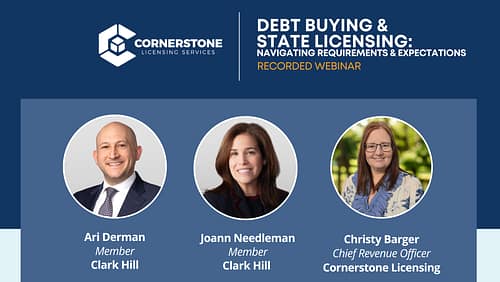 Our most recent webinar dove into debt buyer licensing, passive debt purchaser risk, and the growing complexity around portfolio structure. We covered how states are taking a closer look at entity naming, SPV structures, affiliated entities, asset class triggers, and the licensing questions that come up long before collection activity begins. A big part of the conversation focused on how much has changed over the last few years, and why licensing strategy needs to be addressed early when deals are being structured.
We’ve recorded the full webinar, and it’s now available to watch on your schedule.
WATCH NOW
FDIC PROPOSES AML FRAMEWORK FOR PAYMENT STABLECOIN ISSUERS
The FDIC approved a proposed rule establishing Bank Secrecy Act, sanctions, and anti-money laundering expectations for certain permitted payment stablecoin issuers under the GENIUS Act framework. The proposal would align stablecoin issuer oversight more closely with existing FinCEN and OFAC requirements while clarifying examination and enforcement expectations for covered entities. The move signals continued convergence between digital asset regulation and traditional financial institution supervision. For fintech companies, stablecoin issuers, money transmitters, and banking organizations exploring digital asset activity, the proposal highlights increasing federal focus on AML controls, sanctions screening, and operational governance for payment stablecoin programs.
TRUMP EXECUTIVE ORDER TARGETS FINTECH REGULATORY FRAMEWORKS
President Trump signed an executive order directing federal financial regulators to review supervisory practices, licensing processes, and regulatory frameworks that may impede fintech innovation and competition. The order also asks the Federal Reserve to evaluate potential payment system access pathways for certain nontraditional financial institutions and digital asset firms. While the order does not immediately change existing law, it signals continued federal interest in expanding fintech participation in payment infrastructure and reducing regulatory barriers tied to emerging financial technologies.
CT UNLICENSED DEBT COLLECTION ACTIVITY TARGETED
The Connecticut Department of Banking issued a temporary cease and desist order against a California-based company accused of placing Connecticut consumer accounts with a licensed collection agency without holding its own Connecticut license. Regulators also alleged the company may have engaged in debt buying activity without proper state authorization, though that issue has not yet been formally adjudicated. In addition to ordering the company to halt collection activity, the state is seeking restitution and cited the company’s failure to respond to regulatory information requests as a separate violation carrying additional penalty exposure. The action serves as another reminder that Connecticut continues to take an aggressive position on licensing requirements tied to debt collection and debt buying activity, including indirect collection arrangements involving third-party agencies.
LENDER LICENSING GUIDE
If you’re launching or expanding a lending program, this guide lays out what it takes to be license-ready across states, before timelines and product plans get boxed in

What’s Included:
- Consumer vs. commercial licensing footprint
- Federal expectations
- State licensing nuance
- Bonds, net worth, & insurance expectations
- Common pitfalls that create delays
MD LICENSING RULES FOR LOAN ASSIGNEES REVISED
Maryland enacted Senate Bill 784, repealing an exemption that previously allowed certain assignees of mortgages, mortgage loans, and installment loans to avoid state licensing requirements under Maryland consumer credit laws. Beginning July 1, 2026, entities acquiring or holding Maryland consumer loans may face increased scrutiny around licensing obligations under the Maryland Mortgage Lender Law and Maryland Consumer Loan Law. The change is especially relevant for debt buyers, secondary market participants, fintech platforms, and structured finance entities evaluating whether ownership arrangements trigger state licensing requirements.
LENDING RISK EBOOK COMING SOON!
Deep dive into the regulatory pressures shaping nonbank lending today, from licensing and supervision to partnerships, servicing, product design, and data governance. Developed in collaboration with Chuck Dodge of Hudson Cook.
Join the list to get the ebook The State of Regulatory Risk in Lending as soon as it’s released!
NY DFS URGES ENHANCED CYBERSECURITY CONTROLS
The New York Department of Financial Services issued new guidance urging regulated financial companies to strengthen cybersecurity defenses during periods of heightened geopolitical and technological risk. The guidance specifically references evolving AI capabilities as a growing factor in cyber threat activity and encourages firms to move beyond baseline cybersecurity requirements when risk conditions intensify. DFS highlighted areas including phishing-resistant multi-factor authentication, expedited patching, network segmentation, intrusion monitoring, backup testing, and incident response planning.
BUSINESS FORMATION
Choosing the right business structure is a critical decision as it affects the legal, financial, and operational aspects of the business, as well as its growth and success. There are many differing business structures and factors such as the number of owners, liability protection, taxation, and management structure play a role in determining the best structure.
We are here to guide you through this exciting journey. Our team of experts is well-versed in business formation and can help you navigate the complexities. We’ll assist you in choosing the most suitable business structure that aligns with your goals and needs, filing all the necessary paperwork swiftly and accurately. Let us handle the technicalities while you focus on what truly matters – growing your business.
VERMONT ENACTS COERCED DEBT PROTECTIONS
Vermont Governor signed H.385 into law, creating new protections for consumers claiming debt was incurred through domestic abuse, fraud, intimidation, human trafficking, or unauthorized use of personal information. The law requires creditors to halt certain collection activity and investigate qualifying coerced debt claims once required documentation is received. The measure also creates civil liability exposure tied to violations and includes additional protections involving suspicious financial transactions and vulnerable consumers. The law reflects growing state scrutiny around coerced debt disputes, financial exploitation, and credit reporting obligations.
OKLAHOMA ENACTS MONEY TRANSMISSION MODERNIZATION ACT
Oklahoma HB 3521 became law on May 13, 2026, creating the Oklahoma Money Transmission Modernization Act. The law replaces the state’s prior framework with a broader licensing structure for money transmitters and expands the Banking Commissioner’s examination and enforcement authority. The measure also aligns Oklahoma more closely with multistate licensing standards through NMLS while adding new requirements tied to control changes, authorized delegates, net worth, permissible investments, reporting, and operational oversight. For money transmitters, payroll processors, and fintech companies operating in Oklahoma, the law represents a significant licensing and operational change that will require close review of scope, exemptions, and transition timing.
NY BNPL LAW PUTS ZERO-INTEREST PRODUCTS IN LICENSING SCOPE
New York passed a buy now, pay later licensing law that brings many zero-interest pay-in-four products into state lending oversight. The law applies regardless of whether interest is charged and also reaches platforms facilitating third-party lending activity, meaning some providers previously operating outside traditional lending frameworks may now fall within scope. New York regulators have also proposed implementing rules that would impose disclosure, fee, underwriting, dispute resolution, and data governance requirements on covered providers. The measure carries significant consequences for unlicensed activity, including potential voiding of loans and misdemeanor exposure. For BNPL providers, fintech platforms, and bank-partner programs, the law signals broader state movement toward expanded licensing treatment for installment-style products.
BEYOND THE NEWSLETTER

Head to LinkedIn and give us a follow to tap into a stream of real-time updates, legislative changes, and great content tailored for ARM and Fintech professionals. Engage with thought leaders and peers in our community to enhance your expertise.
Follow Cornerstone on LinkedIn and transform the way you stay informed in our ever-evolving industry.
MA UNLICENSED LOAN SERVICING ACTIVITY TARGETED
The Massachusetts Division of Banks entered into a $1.9 million settlement with a fintech company over allegations it engaged in third-party loan servicing activity without the required state registration. Regulators alleged the company serviced loans in Massachusetts for several years before submitting a registration application through NMLS in 2025 after recognizing the requirement. The settlement required the company to cease unlicensed activity immediately and implement policies designed to prevent future licensing violations. The action reflects continued state scrutiny of fintech servicing models and reinforces the importance of evaluating whether operational activities trigger state servicing, lending, or money transmission requirements.
GA FEDERAL COURT LIMITS TCPA DO NOT CALL CLAIMS FOR TEXT MESSAGES
A federal court in Georgia dismissed TCPA Do Not Call claims based on telemarketing text messages, ruling that text messages do not qualify as “calls” under Section 227(c) of the statute. The court relied on the Supreme Court’s recent Loper Bright decision and concluded the term “telephone call” must be interpreted based on its meaning when the TCPA was enacted in 1991. The ruling adds to a growing body of decisions limiting the scope of TCPA Do Not Call provisions for text messaging activity, though the issue remains unsettled nationally.
TX ENFORCEMENT ACTIONS EXPAND MONEY TRANSMISSION SCRUTINY
Texas regulators issued enforcement orders against a payroll processor and a surrogacy escrow provider for allegedly engaging in unlicensed money transmission activity. The actions reinforce Texas’ increasingly broad interpretation of money transmission triggers, including certain payroll processing and escrow-related activities involving the receipt and disbursement of funds. The orders also required licensing remediation efforts, operational wind-down provisions, and financial penalties.
CA LICENSE NUMBER DISCLOSURES SPUR NEW COLLECTION LITIGATION
Collection agencies continue facing lawsuits in California over alleged failures to include required state license numbers in written and digital collection communications. Recent complaints claim the omission violates both the FDCPA and California’s Rosenthal Fair Debt Collection Practices Act, which requires covered debt collectors to display their California license number in at least 12-point type on certain communications. The cases reflect growing litigation risk tied to technical disclosure requirements and reinforce the importance of reviewing communication templates, email workflows, and vendor-generated notices for state-specific disclosure obligations.
EDUCATION DEPARTMENT FINALIZES MAJOR STUDENT LOAN RULE CHANGES
The U.S. Department of Education finalized a multi-year set of student loan rule changes taking effect in stages beginning July 1, 2026. The changes include new borrowing limits, elimination of the Grad PLUS program, revised rehabilitation rules, and a new income-driven Repayment Assistance Plan. For collection agencies, servicers, and businesses handling student loan accounts, one major operational change arrives in 2027, when borrowers will be allowed to rehabilitate defaulted loans twice instead of once, potentially affecting outreach strategies, account treatment, training, and system workflows.
IL CENTRALIZED CONSUMER COMPLAINT PORTAL
The Illinois Department of Financial and Professional Regulation launched a new online complaint portal consolidating consumer complaints for the state’s banking and financial institutions divisions into a single system. State officials said the platform is intended to improve complaint tracking, identify industry trends earlier, and strengthen mediation efforts involving debt collection, money transmission, consumer lending, and mortgage servicing. The move signals continued growth in state-driven consumer protection enforcement and increased visibility into complaint patterns and servicing practices.
SC ENACTS DIGITAL ASSET BILL WITH MONEY TRANSMITTER EXEMPTIONS
South Carolina S 0163 was signed into law on May 19, 2026, creating a broad state framework for digital asset activity. Several categories of crypto activity are exempt from money transmitter licensing requirements, including crypto mining, node operations, developing on-chain applications, and crypto-to-crypto trading. The law also bars state and local government entities from accepting or requiring payment in central bank digital currency and includes additional provisions affecting digital asset use, taxation, and mining operations.
MD EXPANDS SPONSORSHIP RULES FOR INSURANCE PRODUCER-MORTGAGE LOAN ORIGINATORS
Maryland enacted House Bill 38, expanding who may sponsor affiliated insurance producer-mortgage loan originators effective October 1, 2026. Under the new law, commissioner-approved mortgage lenders and mortgage brokers may sponsor these licensees, replacing prior employment-based language with a more flexible sponsorship framework. The law preserves key supervisory responsibilities, operating restrictions, and surety bond requirements while potentially opening new partnership structures within Maryland’s residential mortgage market.
CA ROHIT CHOPRA NAMED TO LEAD REORGANIZED CONSUMER AGENCY
California Governor Gavin Newsom appointed former CFPB Director Rohit Chopra to lead the state’s new Business and Consumer Services Agency, launching July 1, 2026. The agency will consolidate several California departments and boards, including the DFPI, Department of Consumer Affairs, and Department of Real Estate, under one structure focused on consumer protection, licensing, and business oversight. For financial services companies, lenders, collectors, and fintech firms, the move may signal closer coordination between California’s licensing, examination, and enforcement functions.
This information is not intended to be, nor is it, legal advice. It is intended for information purposes only. We make no warranty, express or implied, as to the accuracy or reliability of this information. We are not attorneys. You must retain your own attorney to receive legal advice. While Cornerstone strives to provide the most current and accurate state licensing information, the responsibility for any decision related to state licensing or agency compliance is solely yours.