
COLORADO UPDATES MONEY TRANSMITTER LICENSING
Colorado has adopted the Model Money Transmission Modernization Act (MTMA), set to take effect August 6, 2025, replacing the state’s existing money transmitter licensing framework. The updated law introduces a higher net worth requirement—now $100,000 based on transaction volume—and reduces the minimum surety bond from $1 million to $250,000.
It also codifies key exemptions for payroll processors and agent-of-the-payee arrangements, providing regulatory clarity for fintechs and payment facilitators. Companies currently operating or planning to expand in Colorado should assess whether their activities require updated licensing or bonding strategies under the new rules.
NEW JERSEY LICENSE SCAM ALERT
The New Jersey Division of Consumer Affairs has issued an urgent alert warning licensees about phishing emails impersonating state agencies. These fraudulent messages instruct recipients to download “new license software,” which actually installs malware. The agency emphasized that no software download is ever required for license renewals or applications. Professionals are advised to avoid suspicious links and report any fraudulent messages to the appropriate authorities.
MARYLAND REVISES DEBT COLLECTION LICENSE FEE STRUCTURE
Starting in Fiscal Year 2026, the Maryland Office of Financial Regulation (OFR) will shift from a branch-based to an activity-based licensing assessment model—a change that could result in lower fees for many debt collection agencies and other licensed businesses.
Instead of calculating fees by the number of physical branches, assessments will now be based on business activity volume within Maryland, creating a more equitable fee structure. Nearly 4,000 licensed entities across nine financial service industries will be impacted, with individual assessment notices issued via NMLS in the coming weeks.
Assessment notices will be issued via NMLS, with payments due within 30 days.
RESOURCE
MORTGAGE STATE LICENSING MAP
Cornerstone has launched a powerful new interactive Mortgage State Licensing Map, a free, real-time resource to help mortgage professionals eliminate guesswork and stay on top of shifting state requirements. Now integrated with the Client Portal, this tool empowers lenders and brokers to move faster, stay compliant, and reduce risk.
Key highlights:
- Covers all 50 states + D.C. + Puerto Rico with licensing, bond, and renewal info
- Instantly view surety bond amounts by license class
- Understand registered agent requirements
- Snapshot of background check standards—great for staffing
- Real-time updates as laws change—no more outdated spreadsheets
Check out the new mortgage licensing map now!
EXPLORE THE MAP
MAINE BANS MEDICAL DEBT REPORTING
Maine is the latest state to prohibit the reporting of medical debt to consumer reporting agencies. The law bars medical creditors, debt collectors, and debt buyers from furnishing medical debt information to credit bureaus, regardless of payment status or consumer repayment activity.
The statute amends the Maine Fair Credit Reporting Act, replacing “medical expenses” with “medical debt” and eliminating previous exceptions that allowed limited reporting.
TEXAS REGULATED LENDERS TRANSITION TO NMLS STARTING JULY 15
Beginning July 15, 2025, all Texas Regulated Lender licenses will transition from the ALECS system to NMLS, with the deadline for completion set for September 15. All transactions—including renewals, amendments, and new applications—must be submitted through NMLS going forward.
Licensees should begin preparing by securing IRS documents that exactly match the entity name and FEIN, as required by NMLS.
Cornerstone can manage this entire transition for you—saving time and ensuring accuracy. Contact us today to get started.
WEBINAR
LICENSING FOR STUDENT LOAN SERVICERS
Our recorded webinar is now available—make sure you’re fully licensed before diving back into student-loan recovery.
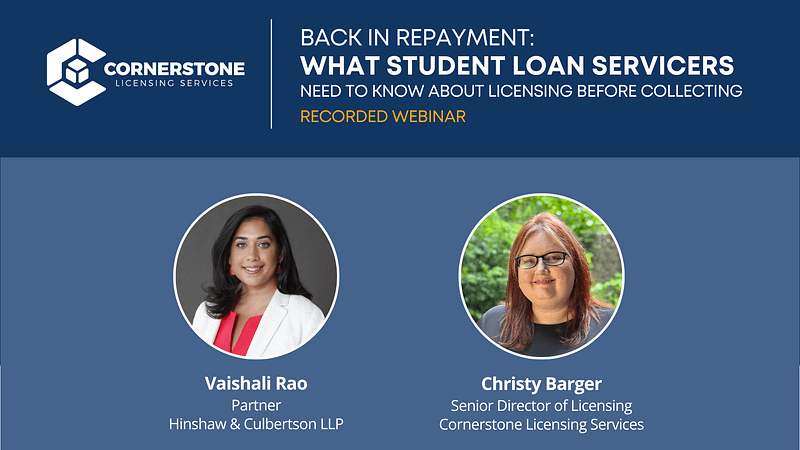 WHAT WE COVERED:
• Evolving Licensing Landscape: We unpacked why a standard debt-collection license often falls short for student-loan work, and how 15+ states now require specialized servicer permits tailored to federal and private portfolios.
• State-by-State Deep Dives: From California and Illinois’ default-only licenses to Colorado and Massachusetts’ broader frameworks—and a watchlist on New York/New Jersey—we explored the nuances, timing requirements, and common exemptions you need to know.
• Federal Preemption Realities: You’ll learn when a DOE contract can’t fully shield you from state rules, how courts draw the preemption line, and why most servicers still need to align with both federal guidelines and state statutes.
• Implementation Roadmap: Step-by-step guidance on navigating application portals (NMLS and direct filings), securing surety bonds, compiling background checks, and preparing your business plan so you’re ready for renewals, reporting requirements, and audits.
• Operational & Legal Best Practices: Why you should embed statutory servicing obligations—like borrower communications protocols and payment-application rules—into your policies and training, and how to avoid slipping into unfair or deceptive trade practice territory.
• Looking Ahead: What to expect as more states consider student-loan servicer laws, the potential for national model-law efforts, and the enforcement trends that will shape compliance over the next few years.
WATCH NOWCONNECTICUT EWA LICENSING AND COMPLIANCE RULES
On June 17, 2025, Connecticut enacted law introducing a new regulatory framework for providers of earned but unpaid wage or salary advances. Effective October 1, 2025, the law requires EWA providers to obtain a license from the Connecticut Department of Banking before offering advances to residents. This applies to both direct-to-consumer and employer-integrated models.
The act also mandates clear consumer disclosures, prohibits prepayment penalties and excessive APRs, and requires providers to offer at least one no-cost advance option per transaction.
Additionally, the law introduces anti-stacking protections, requiring mechanisms to prevent multiple advances against the same earned income, and mandates reimbursement of consumer fees caused by provider error. Connecticut joins a growing number of states creating licensing regimes for EWA.
MARYLAND EXEMPTS CERTAIN TRUSTS FROM MORTGAGE LICENSING
Effective April 22, 2025, Maryland’s enactment of House Bill 1516 exempts two types of trusts from mortgage lender and installment loan licensing requirements: Passive Trusts (which hold but do not originate, broker, or service loans) and Government Trusts (created by U.S. government entities). These exemptions apply regardless of the trust’s state of formation, offering relief for certain secondary market participants.
In response, the Office of Financial Regulation (OFR) has withdrawn prior guidance and proposed rules on this issue.
NEVADA GOVERNOR VETOES MEDICAL DEBT COLLECTION BILL
Nevada Governor vetoed AB 204, a bill that would have placed new restrictions on medical debt collection practices, including a 180-day waiting period and expanded notice requirements. The governor cited concerns that the bill would increase healthcare costs, create administrative burdens, and unfairly penalize providers and patients who meet their obligations. He also warned that the emergency provisions could have halted collections statewide, even in unaffected areas. As a result, existing collection rules remain unchanged in Nevada.
BLOG POST
MONEY TRANSMITTER LICENSING GUIDE FOR FINTECH STARTUPS

Fintech startups entering the payments or crypto space often face a major hurdle early on: obtaining a Money Transmitter License (MTL). This guide from Cornerstone breaks down what an MTL is, who needs one, and how to navigate the federal and state licensing maze—including key steps, pitfalls to avoid, and how licensing ties into long-term growth and bank partnerships. It also highlights state-by-state complexity, special considerations for crypto firms, and the value of integrating licensing into your go-to-market strategy.
Click here to read the full article and safeguard your licensing strategy.
READ MORE
TEXAS: FIRST PUBLICLY FUNDED BITCOIN RESERVE LAUNCHED
On June 22, 2025, Texas made history by passing Senate Bill 21, establishing the Texas Strategic Bitcoin Reserve—the first state-backed reserve funded with taxpayer dollars. Administered by the state comptroller and overseen by a crypto advisory committee, the reserve aims to hedge against inflation and diversify Texas’ financial assets.
Only cryptocurrencies with a 12-month average market cap above $500 billion—currently just Bitcoin—qualify for inclusion. The reserve will operate independently of the state treasury, with biennial public reporting, prudent investment rules, and protections to prevent fund diversion.
VIRGINIA MEDICAL DEBT COLLECTION RESTRICTIONS ENACTED
Virginia Governor has signed the Medical Debt Protection Act into law—introducing new compliance requirements for entities collecting medical debt in the state. Effective July 1, 2025, the law caps interest and late fees at 3% annually and prohibits late fees within 90 days of the final invoice.
The law also bans extraordinary collection actions—including arrest, foreclosure, wage garnishment, and property liens—for debtors who qualify for financial assistance.
OKLAHOMA DATA BREACH LAW AMENDED
Oklahoma has expanded its data breach notification law. Effective January 1, 2026, the definition of “personal information” will include biometric data, expiration dates tied to financial accounts, and electronic identifiers with access credentials.
Breaches affecting 500+ residents require notice to the Attorney General within 60 days. Entities using “reasonable safeguards” and providing timely notice can avoid penalties, but failure to do so may result in fines up to $150,000. Organizations should review and update their data security practices now to prepare.
NEVADA’S NEW DATA SECURITY STANDARDS FOR FINANCIAL SERVICES
Nevada signed into law new data protection rules that align with the FTC Safeguards Rule. Financial services providers—including mortgage servicers, lenders, debt collectors, and fintechs—must implement a comprehensive information security program with administrative, technical, and physical safeguards.
Covered entities are also required to report unauthorized access to customer information to both the FTC and state commissioners. The law defines a “notification event” and mandates prompt reporting under federal standards.
Mortgage servicers managing 2,000+ loans across states face additional oversight, including liquidity requirements, governance standards, and annual risk assessments. Most provisions take effect January 1, 2026.
FLORIDA MONEY TRANSMISSION AND FINANCIAL SERVICES LAWS UPDATED
On June 13, Florida Governor Ron DeSantis signed to amend key portions of the state’s financial institutions code and money services business regulations, effective July 1, 2025. For money transmitters, the bill expands the definition of “control person” to include individuals with direct or indirect authority to vote or sell 25% or more of a class of voting securities, broadening who may trigger licensing and oversight.
Additional financial services updates include new assessment due dates (March 31 and September 30), the ability for regulators to issue certificates of acquisition, and changes affecting credit union governance and reserve requirements. Entities operating in Florida should review the updated definitions and compliance implications tied to control and ownership thresholds.
TEXAS ADVANCES NATION’S MOST COMPREHENSIVE AI LAW
On June 2, the Texas legislature passed the Texas Responsible Artificial Intelligence Governance Act (TX AI Act), which now awaits the governor’s signature. If enacted, it will take effect January 1, 2026, making Texas the fourth state—after Colorado, Utah, and California—to pass dedicated AI legislation.
The bill creates a comprehensive compliance framework for AI developers and users, including disclosure requirements, anti-discrimination rules, and restrictions on harmful or deceptive applications. Financial institutions and insurers are exempt from certain provisions if already regulated under existing laws. The Texas Attorney General will oversee enforcement, with penalties ranging from $10,000 to $200,000, plus daily fines for continued violations.
Meanwhile, Congress is considering a 10-year federal moratorium on state and local AI regulation, which could preempt laws like Texas’s if enacted.
CORNERSTONE CAN HELP
SURETY BONDS
Surety Bonds can feel like just one more hassle standing in the way of your compliance. You want to close the loop on your licensing or permitting requirements and get back to what you do best – running your business. But the process can be slow, costly, and downright stressful. And while you’re waiting, you’re losing out on potential clients and revenue.
At Cornerstone, we understand and we’re here to help. Our team of experts work tirelessly to get you the surety bond you need quickly and at a fair price. No more lengthy waits for a response or being hit with hidden fees. Plus, our dedication to exceptional customer service ensures a stress-free experience from start to finish.
.
GET STARTED
NORTH DAKOTA EXPANDED “LOAN” DEFINITION—ALTERNATIVE FINANCING NOW AT RISK
North Dakota has passed House Bill 1127, amending the Money Brokers Act (MBA) to include a new definition of “loan” that could bring alternative financing products—like merchant cash advances and factoring—under licensing and rate cap requirements. Effective August 1, 2025, the revised law allows the Department of Financial Institutions (DFI) to designate such products as loans by order, but even without such an order, courts may interpret them as loans due to the broad statutory language.
If applied, this would require providers to obtain an MBA license and comply with the 36% annual rate cap, creating new regulatory and legal exposure. While the DFI’s intent remains unclear, the move could significantly impact fintechs and nonbank lenders offering flexible working capital solutions in the state.
INDUSTRY NEWS
SENATE PASSES GENIUS ACT, ESTABLISHING FIRST FEDERAL STABLECOIN FRAMEWORK
On June 17, the U.S. Senate passed the GENIUS Act, marking the first federal legislation to regulate dollar-pegged stablecoins, with broad implications for banks, fintechs, and retailers. If enacted, the law would centralize oversight under the U.S. Treasury, requiring full reserve backing, monthly audits, and AML compliance for all issuers.
The bill opens the door for regulated private companies to issue stablecoins, while limiting issuance by large tech firms unless partnered with financial institutions. Although it still requires reconciliation with the House’s competing bill, GENIUS signals a major shift toward federal-level crypto regulation. Firms exploring digital payment models should begin reviewing how these emerging rules could reshape compliance and product development.
NEVADA EASES LICENSING FOR INTERNET CONSUMER LENDERS
Nevada has amended its Installment Loan and Finance Act, eliminating the in-state office requirement for licensed Internet consumer lenders—a shift for fintechs and online consumer lending programs. Effective October 1, 2025, this change allows eligible lenders to operate and apply for a license from outside Nevada, while still requiring the standard Installment Loan Company License.
The law defines Internet consumer lenders as those who make, solicit, or facilitate consumer loans exclusively online, including bank partnership programs. It also introduces contract requirements, such as applying Nevada law to loan agreements—though this does not apply to loans made by federally or state-chartered banks under federal preemption.
By loosening restrictions on shared office space and exempting internet lenders from certain operational limitations, the law gives fintechs greater flexibility in how they structure their business models in Nevada—opening the door to broader market access.
VIRTUAL SUGGESTION BOX
We’ve continued to hear great feedback from you, our clients, on how our newsletter provides value for your organization. To ensure we continue to research and provide the best data, we have created a virtual “suggestion box” for your ideas. Whatever topic you’d like to learn about, large and small, we will go research with our team and knowledgeable folks from our industry.
SUGGEST A TOPIC
MASSACHUSETTES TRANSITION TO MONEY TRANSMITTER LICENSE
Massachusetts will begin transitioning Foreign Transmittal Agency and Check Seller licensees to a new Money Transmitter License as part of its updated statutory framework. The transition process begins November 1, 2025 via the Nationwide Multistate Licensing System (NMLS), and applies to all current licensees in good standing.
New applicants can begin filing through NMLS starting July 1, 2025, but licenses will not be issued before January 1, 2026. Businesses must submit their applications by July 1, 2026 to continue operating while under review. Updated NMLS transition checklists and requirements will differ from previous renewals, and licensees should prepare for changes in documentation and standards.
BEYOND THE NEWSLETTER

Head to LinkedIn and give us a follow to tap into a stream of real-time updates, legislative changes, and great content tailored for ARM and Fintech professionals. Engage with thought leaders and peers in our community to enhance your expertise.
Follow Cornerstone on LinkedIn and transform the way you stay informed in our ever-evolving industry.
FOLLOW US
OREGON BANS MEDICAL DEBT FROM CREDIT REPORTS
On June 17, Oregon enacted SB 605, prohibiting hospitals, affiliated clinics, and debt collectors from reporting medical debt to consumer reporting agencies. The law enhances consumer protections by also capping interest rates on medical debt and requiring financial assistance screenings before accounts are referred to collections. Violations are classified as unlawful practices, and courts may declare such debts void and uncollectible.
MARYLAND LICENSING LAW ENACTED FOR EARNED WAGE ACCESS PROVIDERS
Maryland has passed the Earned Wage Access and Credit Modernization Act, introducing licensing requirements and fee limits for third-party Earned Wage Access (EWA) providers. Effective October 1, 2025, the law marks a significant step in regulating the rapidly growing EWA sector, which allows workers to access wages before payday.
The new law excludes employers who directly advance wages to employees or contractors, focusing instead on third-party fintech platforms. Providers will now need to obtain a license to operate in Maryland and comply with specific pricing and operational rules.
INDSTRY NEWS
CRYPTO BILL CLEARS HOUSE COMMITTEES
The CLARITY Act, a bill to shift federal oversight of digital assets from the SEC to the CFTC, passed out of both the House Financial Services and Agriculture Committees with bipartisan support. The legislation aims to establish a clearer regulatory framework for digital commodities and intermediaries, including crypto firms. If enacted, it would mark a significant change in how digital assets are supervised in the U.S. Businesses in fintech and blockchain should prepare for new compliance expectations under the CFTC’s jurisdiction.
NEW YORK CYBERSECURITY & SANCTIONS COMPLIANCE ALERT AMID GLOBAL CONFLICT
On June 24, 2025, the New York Department of Financial Services (NYDFS) issued updated guidance to regulated entities in response to rising geopolitical risks. The alert emphasizes enhanced vigilance around cybersecurity, OFAC sanctions compliance, and virtual currency controls.
Key recommendations include updating risk assessments, testing incident response plans, improving vendor oversight, and strengthening monitoring of trade finance and virtual currency transactions. Entities must also ensure OFAC compliance programs and transaction monitoring systems are updated to reflect evolving threats and regulatory expectations.
This information is not intended to be, nor is it, legal advice. It is intended for information purposes only. We make no warranty, express or implied, as to the accuracy or reliability of this information. We are not attorneys. You must retain your own attorney to receive legal advice. While Cornerstone strives to provide the most current and accurate state licensing information, the responsibility for any decision related to state licensing or agency compliance is solely yours.