
INDUSTRY NEWS
STUDENT LOAN SERVICING RESTARTED—VERIFY YOUR LICENSES
With federal student loan collections back in effect since May 5, wage garnishments and other enforcement measures are once again in force. A standard debt-collection license may no longer suffice—many states now mandate a dedicated student-loan servicer or collector permit. Exemptions are limited, and debt buyers must navigate state-specific rules when purchasing federal or private loan portfolios. Don’t risk costly missteps or enforcement actions: audit your licensing footprint immediately and engage with specialists who can secure the proper authorizations across all jurisdictions. Reach out to Cornerstone today to confirm you’re fully licensed for student loan servicing.
CONNECT WITH US
WEBINAR
MUST WATCH FOR STUDENT LOAN SERVICERS
Student loan collections have resumed as of May 5—are you properly licensed to jump back into recovery? Join our webinar to ensure your agency meets today’s state licensing requirements and legal standards as borrowers return to repayment.
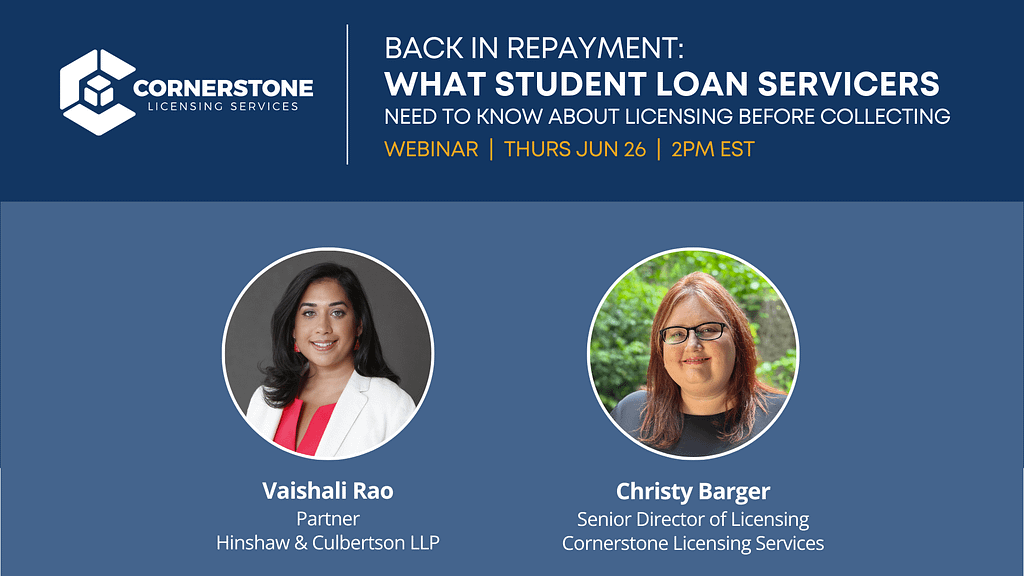 WHAT TO EXPECT:
The Current Landscape: Implications of the DOE’s collections restart and critical operational and legal checkpoints
Licensing Deep Dive: States requiring specialized student-loan servicer or collector permits, available exemptions, and how to craft a solid licensing strategy
Implementation Essentials: Securing your Certificate of Authority, surety bonds, and specialty licenses, plus renewal and reporting best practices
Legal Considerations: Navigating federal preemption, balancing state and federal oversight, and why licensing matters even with federal exemptions
Future Outlook: Key regulatory changes on the horizon and tools to keep your team ready
Don’t risk delays or penalties—reserve your spot now and ensure you’re properly licensed for the next phase of student loan recovery.
REGISTER NOW
NEW YORK
NY BNPL LICENSING IMPOSED AS CFPB WITHDRAWS
New York’s 2026 budget codifies the first state licensing regime for buy now, pay later (BNPL) providers, filling the gap left by the CFPB’s recent retreat under the new administration. Under the new law, any firm offering installment or zero-interest BNPL plans must secure a state license, adhere to credit-disclosure and dispute-resolution standards, implement data-privacy protections, use risk-based underwriting, and cap fees and charges—mirroring key Truth in Lending Act safeguards. A new licensing requirement is now in effect for nonbank lenders issuing BNPL products.
Reach out to the professionals at Cornerstone for help- we can handle everything needed to obtain your license.
INDUSTRY NEWS
FCC PROPOSES ROBOCALL AUTHENTICATION RULES
The FCC has put forward a proposal to require telecom providers to embed digital “passports” in every phone call, ensuring the displayed caller ID truly matches the originator. Currently, only internet-based calls use this authentication, but the new rule would extend it to traditional switch-based networks, closing a loophole that robocallers exploit. If adopted, all voice carriers must implement end-to-end digital signatures within two years, so calls can be marked as verified or unverified. This change aims to cut down on spoofed numbers and unwanted spam calls by giving recipients confidence in who’s calling. Carriers should start evaluating their systems now to meet the forthcoming registration and technical-safeguard requirements.
INDUSTRY NEWS
HOUSE UNVEILS CRYPTO REGULATORY BILL
House leaders released a draft bill on May 5 proposing the first comprehensive U.S. framework for digital assets. It would classify tokens under the CFTC or SEC—allowing for reclassification—while carving out a distinct category for payment stablecoins. Cryptocurrency exchanges and trading platforms must register as MSBs with FinCEN under the Bank Secrecy Act and implement anti–money-laundering programs. Issuers of new digital assets must disclose key details to regulators, whereas developers and infrastructure providers receive tailored exemptions. Depending on their classification, market participants may also need to register with the SEC (for securities) or CFTC (for commodities), introducing clear registration and operational standards across the industry.
INDUSTRY NEWS
SOUTHWEST BORDER GTO PAUSED BY COURTS
FinCEN’s Geographic Targeting Order, which went live April 14 and would have forced money services businesses in 30 U.S.–Mexico border ZIP codes to file Currency Transaction Reports for any cash deal over $200, has hit legal roadblocks. In Texas, a trade group secured a temporary restraining order arguing the new reporting mandate under the Administrative Procedure Act and Fifth Amendment was arbitrary and imposed ruinous administrative burdens. Days later, an MSB in San Diego won a separate TRO in federal court, claiming the rule swept up private transactions without individualized suspicion, violating the Fourth Amendment. Both orders halt GTO enforcement for covered firms in those districts while preliminary injunction hearings proceed. Most recently, a preliminary injunction extended those blocks—now preventing enforcement at ten Texas MSBs—after courts found the order likely exceeds Treasury’s Bank Secrecy Act authority.
BLOG POST
MORTGAGE SERVICER LICENSES AND BEYOND: SECONDARY MARKET PARTICIPANTS

Secondary market participants, such as mortgage note buyers, loan servicers, and investors—must navigate a complex patchwork of state licensing rules that now increasingly cover post-origination activities. Recent regulatory updates in key states like California, New York, Texas, and Florida mean that buying, servicing, or enforcing mortgage loans can unexpectedly trigger licensing obligations. This summary offers high-level strategies for early due diligence, aligning activities with properly licensed entities, and staying on top of rule changes to avoid costly compliance gaps. Click here to read the full article and safeguard your licensing strategy.
READ MORE
NORTH DAKOTA
ND GLBA SAFEGUARDS RULE ADOPTED
North Dakota bill, effective August 1, codifies the federal GLBA Safeguards Rule—along with its updated breach-notification requirements—into state law for nonbank financial corporations, including collection agencies, debt-settlement firms, money transmitters, mortgage originators, and servicers. Mirroring the FTC’s standards, providers must notify the Commissioner of any cybersecurity incident affecting 500 or more consumers and still follow existing state breach-notification statutes for larger events. Licensed entities should review their security programs to ensure they meet both federal and now explicitly state-enforced requirements.
CALIFORNIA
CA DATA BROKER REGISTRATION FINE
California’s Privacy Protection Agency has enforced its Delete Act by levying a $46,000 penalty—the maximum under the law—against National Public Data (Jerico Pictures) for failing to register and pay required annual fees as a data broker. The agency’s action follows a major breach that exposed 2.9 billion records, underscoring the state’s commitment to vetting entities that collect and sell personal information. This enforcement highlights that data brokers must secure proper registration or face hefty fines and administrative actions. Licensed financial firms and service providers working with data brokers should verify their partners’ registration status to avoid downstream risks.
INDUSTRY NEWS
CFPB MAY SNAPSHOT: ROLLBACKS OPEN BANKING, NONBANK OVERSIGHT & EFT RULES
This month, the CFPB has substantially pulled back several major initiatives. It reopened its October open-banking rule—which would have allowed consumers to direct data sharing—and may vacate it entirely, creating uncertainty for providers of account-aggregation services. The Bureau also ceased enforcing, and is considering rescinding, its BNPL rule under the Truth in Lending Act and jointly moved to vacate the medical-debt reporting ban after industry litigation. In mid-May, CFPB withdrew three nonbank proposals: the public registry of enforcement orders, amendments to supervisory-designation procedures, and its interpretive rule extending the Electronic Fund Transfer Act to emerging payment accounts. These roll-backs remove anticipated reporting and procedural burdens—such as new filing requirements and expanded oversight—on MSBs and nonbank lenders. Acting Director Russell Vought further pulled back 67 pieces of prior guidance, including bulletins on medical debt collections and time-barred debts, emphasizing a shift toward overall deregulation and reducing regulatory costs.
INDUSTRY NEWS
CLICK-TO-CANCEL DEADLINE PUSHED
The FTC has postponed full enforcement of its updated Negative Option Rule—known as the “Click-to-Cancel” requirement—from May 14 to July 14, 2025. Once in effect, businesses offering subscriptions, memberships, or other recurring services must let consumers cancel using the same method they signed up, clearly disclose all terms before taking billing information, and secure express, informed consent. Any material misrepresentations about offers or cancellation processes are barred, with penalties now up to $53,088 per violation.
TENNESSEE
DEBT COLLECTOR CYBERATTACK SPARKS LAWSUITS, CONTRACT LOSSES
Tennessee-based Nationwide Recovery Services (NRS) suffered a July data breach that exposed sensitive personal and financial records for over 300,000 individuals, leading to delayed notifications, lawsuits in multiple states, and the loss of a major municipal contract. The incident shows that holding all necessary collection licenses isn’t enough—robust data security is critical. Exposed to negligence and privacy-law claims, NRS’s troubles underscore how a single breach can disrupt operations and reputation. For collection businesses, this highlights the vital role of Cyber Liability insurance in covering breach response, legal costs, and business interruption. Protect your operations—secure cyber liability coverage to keep your business running if the worst happens.
INDUSTRY NEWS
EVOLVING EWA LICENSING: INDIANA & MARYLAND ENACT, OTHERS PENDING
Indiana and Maryland took the lead by enacting the first dedicated licensing regimes for earned-wage access (EWA) providers. Indiana’s law—enacted May 6 and effective January 1, 2026—requires registration, a $100K–$250K surety bond, quarterly reporting on revenues and fees, and consumer safeguards like a no-cost payout option and full disclosure of terms; violations can trigger fines or license suspensions. Maryland’s measure, kicking in October 1, brings EWA under its Consumer Loan Law, caps delivery fees at $5–$7.50, bans tip sharing with employers and credit reporting of nonpayment, and makes unlicensed operations a misdemeanor punishable by fines or jail.
Meanwhile, three more states have pending bills that would impose similar requirements. Maine proposes a registration mandate for remote providers, mandatory fee disclosures, free payout options, and a ban on debt-collection lawsuits for nonpayment. Delaware’s bill would create an EWA license overseen by the State Bank Commissioner, complete with annual renewals and revocation authority. Louisiana is considering rules on tip and fee disclosures, reimbursement of any overdraft charges, and annual reporting of transaction and complaint data. Ohio’s bill would require EWA providers to hold an annual registration—including background checks, net-worth tests, fee disclosures, free payout options, and two-year recordkeeping. EWA firms should track these developments closely and prepare to adjust their licensing applications and operational practices across jurisdictions.
Reach out to the professionals at Cornerstone for help- we can handle everything needed to obtain your license.
BLOG POST
PROTECTING YOUR BUSINESS WITH DEBT COLLECTION INSURANCE SOLUTIONS

Commercial insurance isn’t optional in the debt collection and debt buying industry—it’s critical protection against lawsuits, data breaches, and operational disruptions. We specialize in tailored Errors & Omissions and Cyber Liability policies that cover FDCPA claims and cyber-attack fallout, backed by 27 years of ARM expertise. Our whole-market brokerage approach shops top carriers to secure robust, competitively priced coverage. Click here to read the full article and discover how to safeguard your business today.
READ MORE
NEW YORK
NY STATE-EXCLUSIVE DEBT COLLECTOR LICENSING PROPOSED
New York proposes to centralize all consumer debt–collector licensing under state authority, redefining who counts as a “debt collector” and requiring most firms to apply for a license (and pay fees) with the Department of Financial Services. Key exemptions include in-house employees, creditor agents collecting on their own accounts, and companies servicing only current loans. The proposal also preserves any city ordinances in places with populations over one million—provided they match or exceed the state’s procedures and are formally registered with DFS. If passed, core sections take effect January 1, 2028, with remaining provisions following 180 days after enactment.
CORNERSTONE CAN HELP
CYBER LIABILITY
Your data is your lifeblood, and a prime target for cybercriminals. Our Cyber Liability insurance fills that gap, covering breach response costs, legal liabilities, and business interruption losses so you can recover quickly and confidently. With nearly half of cyberattacks aimed at small businesses and most breach victims shutting down within six months, this coverage is essential to keep your operations running strong.
SINGLE POINT OF PROTECTION
Bundle your licensing and insurance under one roof with our commercial insurance services. We partner with vetted global brokerage firms to shop the market on your behalf—leveraging buying power to secure the best coverage and pricing while saving you time and effort. Our specialists cut through jargon and hidden clauses, handle all the legwork, and stand ready to answer your questions, so you can focus on growing your business.
.
GET STARTED
BLOG POST
MORTGAGE DEFAULT LICENSING REQUIREMENTS AND RISKS

Defaulted mortgage loans can transform routine servicing into regulated debt-collection activities, triggering new licensing requirements that mortgage professionals can’t afford to miss. As loans move from performing to non-performing, states such as California, New York, Texas, and Florida impose separate licenses for collections, foreclosures, and charged-off debt buyers—risking enforcement delays or invalidated actions if overlooked. By mapping default-driven licensing needs, vetting special servicers, and confirming standing before foreclosure, firms can stay compliant and competitive. Click here to read the full article and fortify your licensing strategy.
READ MORE
INDUSTRY NEWS
NH & AZ LAUNCH CRYPTO RESERVES
New Hampshire and Arizona have become the first U.S. states to establish official cryptocurrency reserve funds. On May 6, New Hampshire empowers its Treasury to invest up to 5% of fiscal assets—about $3.6 billion annually—in Bitcoin or other market-cap leaders, all held in U.S.-regulated custody or state-controlled multi-signature wallets.
A day later, Arizona’s new law requires unclaimed crypto to remain in its native form for three years before sale and creates a reserve fund for staking rewards, airdrops, and abandoned-asset proceeds, with up to 10% transferable to the general fund. Digital-asset service providers should prepare for these pioneering state-level requirements.
VIRGINIA
VA MEDICAL DEBT PROTECTIONS ENACTED
Virginia’s new Medical Debt Protection Act, signed May 7 and effective July 1, caps interest and late fees on medical debts at 3% annually and prohibits any late charges until 90 days after final billing. For patients qualifying for financial assistance, the law bans extraordinary collection actions—no arrests, property liens, foreclosures, or wage garnishments are allowed. Debt collectors operating in Virginia must adjust their practices to honor these caps and prohibitions or risk enforcement actions under the state’s consumer protection statutes.
TEXAS
TX MERCHANT CASH ADVANCE DISCLOSURE RULES PROPOSED
Texas lawmakers have introduced House Bill 700 and Senate Bill 2677 to bring commercial sales-based financing—like merchant cash advances—under standardized disclosure and usury rules. Providers advancing over $500,000 would need to spell out gross and net proceeds, total repayment and finance charges, payment structures, fees, penalties, and any required collateral. All fees would be reclassified as “interest” subject to Texas’s usury caps, and brokers must register annually with the Department of Banking. Enforcement agencies could levy civil penalties up to $100,000, though no private lawsuits would be allowed. This marks a major shift in how merchant cash advances are treated and follows similar moves in states like California, Florida, and New York. Firms should review how these changes could affect product pricing, transaction terms, and broker licensing.
VIRTUAL SUGGESTION BOX
We’ve continued to hear great feedback from you, our clients, on how our newsletter provides value for your organization. To ensure we continue to research and provide the best data, we have created a virtual “suggestion box” for your ideas. Whatever topic you’d like to learn about, large and small, we will go research with our team and knowledgeable folks from our industry.
SUGGEST A TOPIC
BLOG POST
NON-TRADITIONAL MORTGAGE PRODUCTS: MORTGAGE LICENSING REQUIREMENTS
 Non-traditional mortgage products—from HELOCs and second-lien loans to reverse mortgages and hard-money financing—fall into regulatory gray zones that vary widely by state. Recent rule changes in California, Florida, New York, and Illinois highlight growing scrutiny of these niche offerings and the exemptions that firms often assume apply. To mitigate risk and support strategic growth, lenders and servicers need to map product-specific licensing requirements before entering new markets or scaling existing lines. Click here to read the full article and make sure your licensing strategy is comprehensive and compliant.
INDUSTRY NEWS
SENATE FAST-TRACKS STABLECOIN FRAMEWORK
Congress is moving swiftly on the GENIUS Act, which would establish the first federal rules for payment stablecoins. Under the proposal, stablecoin issuers must register with federal regulators and meet strict capital, liquidity, and consumer-protection standards. The legislation aims to modernize the U.S. payments system and reinforce the dollar’s global role by ensuring all digital-asset firms—domestic and foreign—follow the same guidelines. Money transmitters and lenders that plan to adopt stablecoin settlements should prepare for new licensing obligations and risk-management requirements once the framework is enacted.
BEYOND THE NEWSLETTER

Head to LinkedIn and give us a follow to tap into a stream of real-time updates, legislative changes, and great content tailored for ARM and Fintech professionals. Engage with thought leaders and peers in our community to enhance your expertise.
Follow Cornerstone on LinkedIn and transform the way you stay informed in our ever-evolving industry.
FOLLOW US
This information is not intended to be, nor is it, legal advice. It is intended for information purposes only. We make no warranty, express or implied, as to the accuracy or reliability of this information. We are not attorneys. You must retain your own attorney to receive legal advice. While Cornerstone strives to provide the most current and accurate state licensing information, the responsibility for any decision related to state licensing or agency compliance is solely yours.