
Skip to content

Licensing

"You're Fired!"

← All articles
Filed under Licensing

"What?? How did this happen?!" You've worked your tail off for this client. You've always been first or second in batch track performance, and you get along great with the recovery manager.

OK, so you seem to be getting sued more often and you're spending more time answering complaints. But that comes with the territory, right?? What about all the money you've collected? Doesn't that count?

Not so long ago, the amount your agency collected determined how much business you'd receive in the future. Not anymore. If you don't live up to their compliance standards, then you're not going to receive any future business, regardless of how much you've recovered in the past. Your competitors have learned this lesson well.

If you don't live up to their compliance standards, then you're not going to receive any future business, regardless of how much you've recovered in the past.

Collection partners are now held to the same compliance standards as other third party organizations, including credit bureaus, data providers, and others whose actions could subject the creditor to potential vicarious liability.
cornerstone_scorecard copy

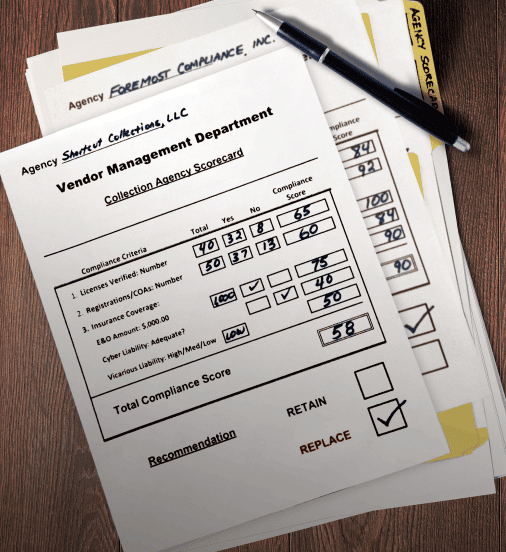
Sophisticated compliance scorecards are being developed and implemented to assess the comparative risk of one partner versus another. Maybe you've let a few licenses lapse and you've only been carrying the minimum E&O insurance, with no TCPA coverage. No big deal? Think again. Collection agencies are now routinely being "fired" by longstanding clients because the risk they represent isn't worth the financial reward they provide.

Where should you focus your attention?

  1. Get and stay licensed and registered in all jurisdictions where your agency could receive placements. Many major clients no longer accept exemptions, and they often require that an agency is registered in all states. Independent initial and ongoing audits/assessments are becoming standard practice.
  2. Obtain more comprehensive E&O and cyber liability insurance coverage. Expect regular independent audits to ensure protection against potential vicarious liability.
  3. Minimize exposure to lawsuits for your clients and your agency by scrubbing your files against known repeat consumer litigants and their attorneys.
  4. Monitor and compare your ongoing litigation and consumer complaints against your competitors. Correct any issues that indicate negative trends.
  5. Implement and maintain a well-documented compliance management system (policies, procedures, training, enforcement, etc.)

Your clients are taking every precaution to eliminate any exposure to unintended risk. Make sure your company isn't eliminated in the process. Adapt, adopt and address these issues to ensure that you're part of their future plans.

Found This Useful? Let's Get You Set Up.

Start an application and an expert will tailor the next steps to your situation.

Related reading

Maryland Rent Collection in 2026: 7 Licensing Risks Property Managers Must Avoid

Licensing

Maryland Rent Collection in 2026: 7 Licensing Risks Property Managers Must Avoid

Property managers in Maryland are running into a question that is getting more attention and creating real operational risk. Does collecting rent, especially when a tenant is past due, trigger Maryland's collection agency licensing requirements?

Licensing Challenges for Mortgage Servicers

Licensing

Licensing Challenges for Mortgage Servicers

Mortgage servicers play a central role in the housing finance system. They collect borrower payments, manage escrow accounts, respond to customer inquiries, and step in with loss mitigation or foreclosure processes when borrowers fall behind. Servicers act as the day-to-day managers of loans after origination, ensuring that cash flows properly between borrowers and investors. Since [...]

The Pros and Cons of Outsourcing Debt Collection for Startups and Small Businesses

Licensing

The Pros and Cons of Outsourcing Debt Collection for Startups and Small Businesses

Cash flow is the lifeblood of every startup. When customers delay or default on payments, even the most innovative ideas can stall. Founders often face a critical challenge: Should we collect overdue invoices ourselves, or hand them off to a third-party debt collection agency? Outsourcing debt collection - sometimes called debt recovery outsourcing - has become increasingly common for [...]

10 Security Tips for Working Remotely

Licensing

10 Security Tips for Working Remotely

Editors Note: In recent weeks many companies were thrust into a situation where they were forced to work remotely or temporarily close the doors. To learn more about the need to manage privacy and security remotely, we sought out wisdom and best practices from an expert in the field. 10 Security Tips for Working Remotely [...]

12 Key Requirements of the FTC's Updated Safeguards Rule

Compliance

12 Key Requirements of the FTC's Updated Safeguards Rule

The FTC's updated Safeguards Rule sets 12 specific security requirements for financial institutions under the Gramm-Leach-Bliley Act. Here is what each one asks for and who has to comply.

15 Licensing Application Process Facts That Delay Approvals

Compliance

15 Licensing Application Process Facts That Delay Approvals

Most licensing delays come from small misses. A payment method that does not work, a stale certificate, the wrong signature, a missing ownership detail. These are the things that slow down filings, trigger deficiencies, and force teams to redo work they thought was finished. We pulled these from the webinar because they came up naturally [...]

Browse the full insights library, meet our editorial team, or download our whitepapers.

Insights

Found This Useful? Let's Get You Set Up.

An expert will respond within one business day.